


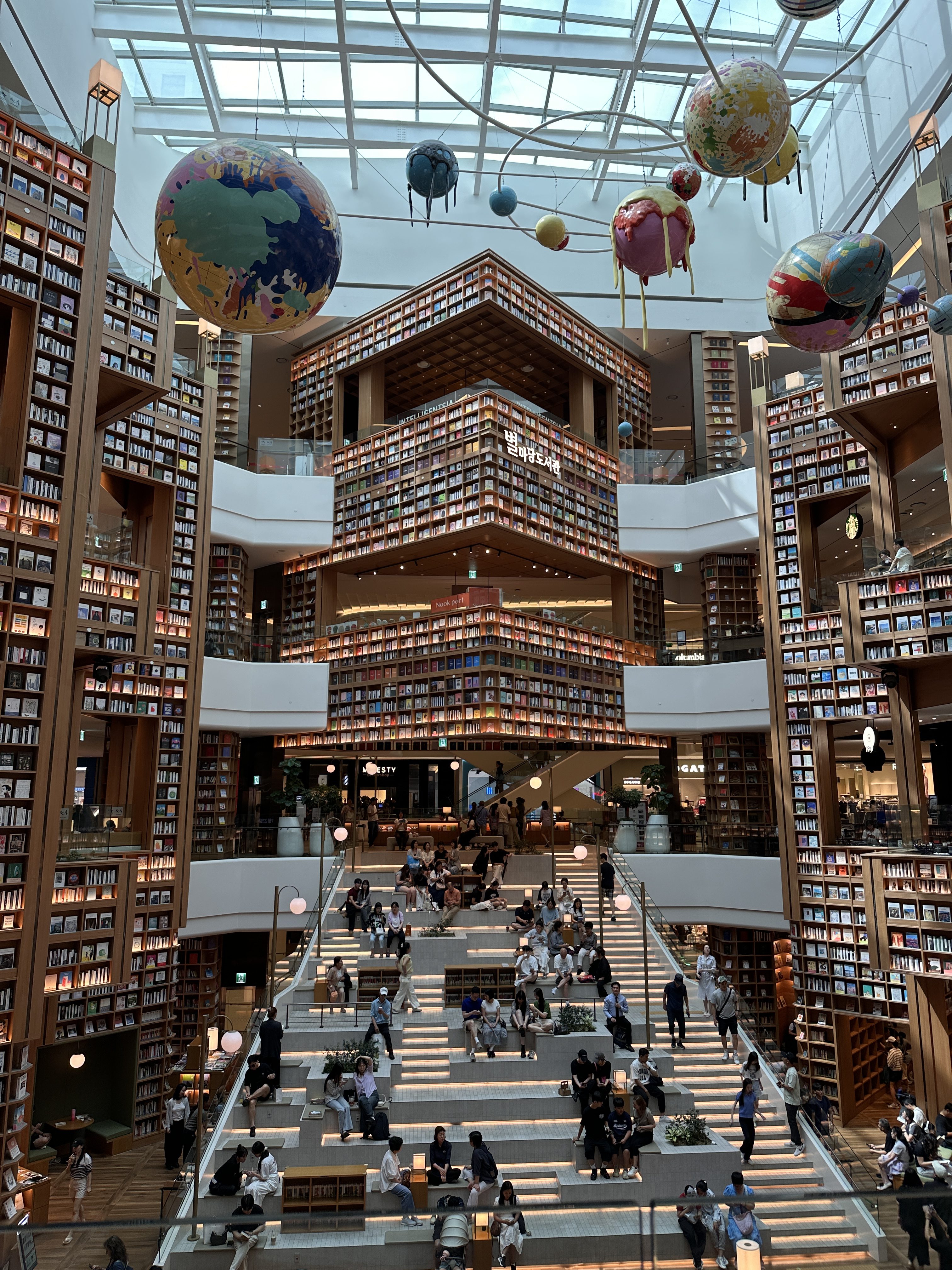
This weekend I took a day trip to Suwon. The main reason I went was to see the Starfield Library inside the Suwon mall, which I had seen on videos and wanted to check out in person. It was located in the center of the building starting on the fourth floor, and it looked just as impressive in person as it did online. After the mall I made my way over to Hwaseong Fortress, which is a UNESCO World Heritage Site built between 1794 and 1796 by King Jeongjo of the Joseon Dynasty. It was originally constructed to honor his father and serve as a military and political stronghold. According to the guide, parts of the fortress was damaged over time and have since been reconstructed, which you could notice in certain sections, as some sections were more vibrantly colored. Throughout the fortress I got to see Nangnamheon Hall, which was one of the few original structures not destroyed, historically used for civil service examinations and ceremonies, as well as the restored Temporary Palace. What stood out to me were the rabbit and moon decorations throughout, which tied into traditional Korean symbolism. I also came across a display of traditional Korean percussion and musical instruments including the Sungonghu, a plucked string instrument, the Woonla, a type of gong, the Banghyang, a stone chime instrument, the Jingo, a large ceremonial drum, the Teukjong, a single hanging bronze bell, the Pyeongjong, a set of tuned bronze bells, and the Teukgyong, a single hanging stone chime.
One of the more interesting things I have observed throughout this internship is how differently communication works here compared to back home. South Korea operates on a high context communication style, while the United States tends to be much more low context. In practice that means a lot more is left unsaid and assumed, with meaning often conveyed through context, hierarchy, and relationships rather than being stated directly. Coming in I understood there would be differences, but the gap between the two styles was more significant than I expected. One example of this in the workplace is how instructions are given each morning. Since the CEO is the only one who speaks fluent English, after the team meeting finishes, he pulls the interns aside and gives us a direct summary of what was discussed and what our tasks are for the day. Without this meeting, we would honestly have very little to go on. Another example would be a presentation we were assigned to build. We put together our first draft in a typical American style, keeping it concise and straight to the point without a lot of text on each slide. The CEO did not like it at all and told us to start over completely. What I learned from that is that Korean presentations work very differently. They tend to cover a lot of information on each slide and can come across as cluttered compared to what I was used to. But it actually makes sense when you understand the context. In Korea, questions are typically not asked at the end of a presentation the way they are in the US (where questions are encouraged after a presentation), so the presentation itself needs to be comprehensive enough to answer any questions the audience might have on its own.
The main source of miscommunication throughout the internship has been the language barrier. Only the CEO speaks fluent English, while my other coworkers can semi-understand what I say. That gap makes it easy for the wrong ideas to get communicated if we are not careful. For anything more serious I rely on Papago or Google Translate to make sure nothing gets lost. It is not a perfect system but it has worked well enough, and I’m relieved that everyone has been really patient throughout. Overall navigating these communication differences has been one of the more challenging but rewarding parts of this experience. Learning to operate in a high context environment where so much is implied rather than stated has pushed me to be more observant and more aware of how I come across in every interaction. Those are habits I will carry with me long after this internship ends.


