


This week, our program took us to Finland’s capital, making it easily one of my favorite weeks abroad. We boarded a cruise line Friday night, danced the night away, and woke up in Helsinki, Finland.
I was separated from my friends for the morning. Most people had signed up to go to the saunas and pools, but I had forgotten to pick an activity until the night prior. This meant that I was going on a guided walking tour of Helsinki. To be frank, I was not thrilled. While my friends would be relaxing in a hot tub for a few hours, I was going to be dragged around Finland for a few hours.
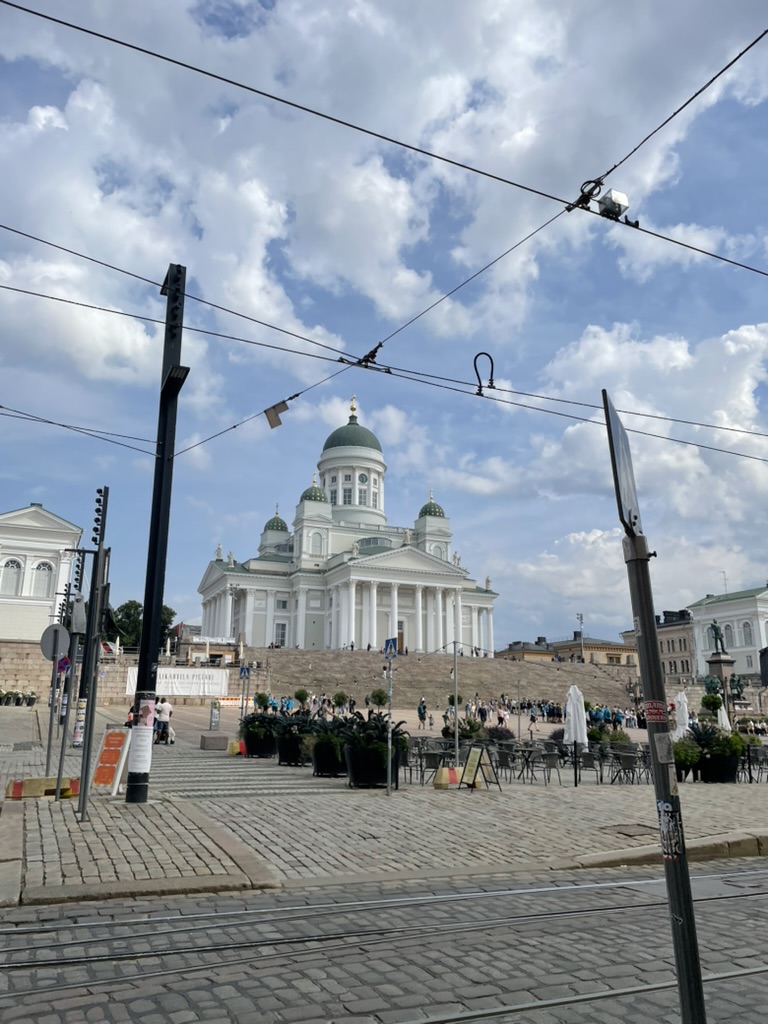
Fortunately, my assumptions were very incorrect. While the pools and sauna did look lovely, I’m glad that I attended the walking tour. We started in the port area (which in a very rude manner overlooked the sauna area that my friends were at) and made our way to the Helsinki Cathedral. This gleaming gold and white building sat in the middle of a huge square, and was shockingly beautiful. It looked as though someone had enlarged a model of a grand, white building with tall pillars and a big green central dome. Statues of the twelve apostles stood on the roof, above massive pillars.

This was the first thing I learned about Finland- it was once controlled by Sweden until Russia conquered it in 1809. This Russian influence is strong, and Helsinki’s city center was intentionally designed to resemble the imperial capital of St. Petersburg. After Russia made Helsinki the capital of the Grand Duchy of Finland in 1812, German architect Carl Ludvig Engel was hired to rebuild the city.
However, my favorite part of Helsinki was their public library. Typing that out felt insane, but it’s true. Walking through the six story building, we walked by 3D printers, music production rooms, huge printing presses, sewing machines, video games- the list goes on. I can easily see myself spending the day in the library messing around with the high quality music equipment or working on a sewing project.
The top floor was a more traditional library, but I was blown away by the architecture of the place. The rows of books sat between a rolling, wavy white ceiling that had intermittent holes that allowed sunlight to pass into the room. Live trees stood beneath the holes, and the whole space felt extremely alive. As the end room tapered into a rounded point, the floor rose, adding a third dimension to the already incredibly interesting room. This place really impressed me, and I would love to see more things like it in the United States. The importance of third spaces has always stood out to me, and I think that the Oodi library does an excellent job of placing a modern twist on the library.

The tour ended here, but I continued to explore Helsinki and ended up meeting up with my friends at the botanical gardens. Like I saw with the library, this place was clearly more than a garden. It was more like an art gallery and wildlife preserve that happened to have an incredible variety of plants and gardens.

Before starting my internship, I would have described my leadership style as hands-off and supportive. I have always believed that people produce their absolute best work when they are given flexibility, trust, and creative freedom. My role as a leader isn’t to dictate every step of a process, but rather to observe from a distance, allow my team to perform freely, and step in only to fill gaps or help solve problems as they arise.
My internship experience abroad, complemented by seeing how European environments operate, has strongly reinforced this core belief.
Working in a new cultural environment highlighted the value of trust in the workplace. Rather than challenging my hands-off approach, this internship proved to me just how effective decentralized, autonomy-focused leadership really is. When individuals are given clear goals and the space to navigate their own paths, they take greater ownership of their outcomes and demonstrate higher levels of initiative.
An unexpected reflection of this came during this weekend trip to Helsinki, Finland. Instead of rigid rules and strict quiet zones, the library provided an open, modern infrastructure, trusting the community to use those resources as they saw fit. It was a physical representation of effective leadership: build a strong supportive foundation, provide the right tools, and then get out of the way so people can innovate.
That being said, this experience has made me a much more intentional and effective leader in two key ways. Firstly, working in an environment with hybrid schedules has sharpened my ability to spot operational “holes” or miscommunications earlier, allowing me to provide subtle support before small issues become big blockers. Further, I now place a higher value on creating a supportive environment, both virtual and physical, where team members feel comfortable experimenting, asking questions, and collaborating without fear of being micromanaged.