


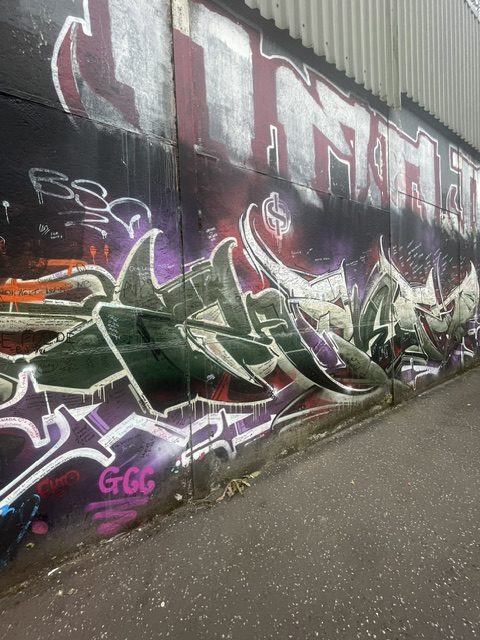

Our first two days in Northern Ireland have been great. The kind of great where you look around and think, “Okay, this place might actually be cooler than I expected.” I knew Belfast would have history and scenery, but I didn’t expect it to feel so alive, or for every neighborhood to feel like it’s carrying its own chapter of a much bigger story.
One moment that really stuck with me was seeing the Peace Walls up close. I expected them to feel like monuments, something symbolic or commemorative. Instead, they felt active — like they still have a job to do. The animosity between communities isn’t something you read about in a textbook; you can actually feel it in the air. The fences, the gates, the separation… it’s all still there. And then you look around and see the social and economic challenges layered on top of that history, and it hits you how complicated life here really is. The Troubles aren’t just writing in a museum. They’re something people still live with, something that shapes neighborhoods, identities, and everyday decisions.


But on a lighter note, the youth centre was one of my favorite parts of the trip so far. Connecting with the kids there was surprisingly comforting. They’re super similar to kids in the US. Same humor, same energy, same chaotic competitiveness in dodgeball and football — or what we call soccer. It was fun seeing how quickly everyone warmed up to us, and it reminded me that even in a place with such a heavy history, there’s still so much joy and normalcy in everyday life. The kids weren’t thinking about politics or conflict; they were thinking about scoring goals and schooling us at football.
Exploring Belfast’s cultural identity has been just as fascinating. The murals, the neighborhoods, the castle, the museum — everything feels like it’s part of a bigger story. You can tell this city has layers, and each place we visited revealed another. And even though we’ve only been here for two days, I already feel like this place is going to change the way I think about communities, history, and what it means to really understand an environment.
